
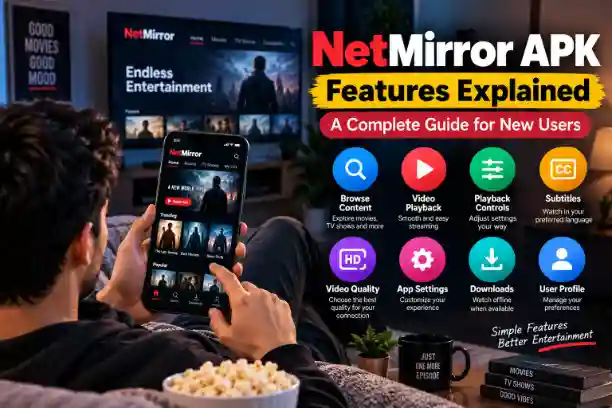
NetMirror APK Features: What Each Option Does
When you install an app for the first time, seeing many buttons and settings can feel confusing. NetMirror APK may also have different options for browsing, playing videos, managing playback, and adjusting the viewing experience. You do not need to understand every option immediately. Most users only need a few basic controls to get started. Once you know what each feature is meant to do, it becomes easier to use the app and adjust it when needed. This guide looks at the common features you may find in NetMirror APK and explains their purpose in simple terms.
Home Screen
The home screen is usually the first place you see after opening the app. It provides access to the main parts of the application and may display available content or different sections. Instead of opening random menus, start by checking the home screen. Look at the navigation buttons and notice how the available sections are arranged. The design can change between versions, so the position of a particular option may not always remain the same.
Search Tool
The search tool is useful when you already know what you want to find. Rather than scrolling through multiple categories, enter the title into the search field. The app can then show matching results when the requested content is available. If your first search does not work, try using fewer words. Spelling can also affect the results. For example, searching for a short part of a title may be more useful than entering a long sentence.
Content Details
Before starting a video, you may see information about the selected content. This area can help you understand what you are about to open. Depending on the version, details may include the title, description, category, or other information. Reading these details can help you confirm that you selected the correct item before starting playback.
Video Player
The video player is where most viewing controls are available. Once playback starts, tapping the screen can reveal the controls. These may include play and pause buttons, a progress bar, volume controls, full-screen mode, and other available options. The controls may disappear automatically after a few seconds so that they do not cover the video. Tap the screen again whenever you need to access them.
Play and Pause
The play and pause controls are basic but important. Use the pause button when you want to temporarily stop playback. Tap play again to continue from the same position. This can be useful if you need to take a short break without closing the video. If the video stops unexpectedly instead of pausing normally, check whether your internet connection is stable.
Progress Bar
The progress bar shows your current position in the video. You can move the slider forward if you want to skip a section. You can also move it backward if you want to replay something. When using the progress bar, remember that moving far ahead may require additional video data to load. On a slower connection, it may take a few moments before the selected position starts playing.
Full-Screen Option
The full-screen option expands the video across the available display. This can make viewing more comfortable, especially on larger phones and tablets. If the player provides a full-screen icon, tap it to switch modes. To return to the normal interface, use the same control or your device’s navigation option. If full-screen mode does not behave as expected, check your phone’s screen rotation settings.
Subtitle Feature
Subtitles can make dialogue easier to follow. If the selected content supports subtitles, you may see a CC or subtitle button inside the player. Open the option and choose from the available languages if more than one is provided. Not every video will necessarily include subtitles. Their availability depends on the content and the version of the service you are using. If there is no subtitle button, it may simply mean that the selected video does not provide this option.
Video Quality
Video quality controls the visual resolution available during playback. A higher quality can make details appear clearer, while a lower quality can reduce the amount of data required for streaming. The right choice depends on your connection and device. If playback keeps stopping, trying a lower available quality may help. If the video already plays smoothly, there is usually no need to change the quality repeatedly.
Audio Controls
Audio controls allow you to manage the sound while watching. You can normally adjust the volume through your Android device. Some video players may also provide their own mute or audio controls. If a video has no sound, check both the device volume and the player controls. Also make sure another application is not controlling your device’s audio output.
Screen Rotation
Screen rotation can change how the video appears on your phone. Portrait mode is useful when browsing or reading information, while landscape mode can provide more space for video playback. Your device’s automatic rotation setting may control this behavior. If the video stays in portrait mode, check whether auto-rotate is enabled.
Settings Menu
The settings menu can contain controls that affect the way the application behaves. Depending on the version, you may find options related to playback, subtitles, language, notifications, or other preferences. Avoid changing several settings at the same time. If you are trying to improve something, change one option and test it first. This makes it easier to understand what each setting actually changes.
Language Options
Some versions may provide language-related settings. These settings can affect parts of the interface or available subtitle options. The exact choices depend on the version and content. If you change the language and find the interface difficult to understand, return to the settings and select a familiar option.
Streaming Performance
The quality of your viewing experience depends on several factors. Your internet speed is one of the most important. Device performance and background activity can also affect playback. If videos take a long time to start, check your connection first. Closing unnecessary apps can also free some system resources. For mobile data users, network coverage can change performance from one location to another.
Cache and Temporary Files
Android apps can store temporary files while they are being used. If NetMirror APK starts acting differently from normal, checking its cache may be useful. Android normally provides cache controls through the app information screen. Clearing cache removes temporary files but does not have the same effect as clearing all app data. If you are unsure which option to select, review the Android warning before confirming.
Storage Management
Available storage is another factor worth checking. A device that is nearly full may have trouble installing updates or running some applications smoothly. You can check storage through Android settings. Remove unnecessary files or applications if you need more space. Keeping some free storage can also make general device management easier.
Version Information
Knowing which version you are using can be useful when troubleshooting. If someone provides instructions for a different version, the menus and features may not match what you see on your device. Before installing an update, check the version number and confirm that the file comes from a source you trust. Do not assume that every file labelled as the latest version is genuine or suitable for your device.
Compatibility
Android devices have different hardware and software configurations. An APK may behave differently depending on the Android version, processor, RAM, and other device characteristics. If the app refuses to install or repeatedly closes, check compatibility information before changing other settings. A compatibility problem cannot always be solved through playback settings.
Basic Troubleshooting
When something does not work, start with simple checks. First, close and reopen the application. Then check your internet connection and make sure your device has enough storage. If a video is buffering, check the connection and available quality options. If the app crashes, check compatibility and whether the installed version is appropriate for your Android device. Avoid making many changes at once. Testing one solution at a time makes troubleshooting much easier.
Tips for First-Time Users
You can make the learning process easier by starting with the most frequently used features. Learn how to search for content, open a video, use the playback controls, adjust quality, enable subtitles when available, and switch to full-screen mode. After that, explore the settings menu. There is no need to change an option simply because it is available. If the current settings work well for you, keeping them unchanged can be the simplest approach.
Final Thoughts
NetMirror APK may include several options that can improve navigation and video playback. The most useful features for new users are usually the search tool, content information, video player, progress bar, subtitles, quality controls, full-screen mode, audio controls, and settings. The exact interface can vary between versions, so some features may appear under different menus or may not be available in every release. Start with the basic controls and learn the other options when you actually need them. Keep your Android device updated, maintain enough storage, use a reliable internet connection, and verify the source of any APK before installing it. Understanding what each option does can make the app easier to navigate and can also help you identify the right setting when a playback or usability issue occurs.